In the context of global food security being threatened by rapid population growth and climate change, 3D food printing (3DFP), also known as additive food manufacturing, is emerging as a breakthrough solution. Far beyond creating visually appealing shapes, this technology promises to revolutionize how we produce, consume, and recycle food.
1. The Rise of "Additive Manufacturing" in the Kitchen
According to estimates from the Food and Agriculture Organization of the United Nations (FAO), global food production must increase by 70% by 2050 to feed nearly 10 billion people. 3D food printing, or additive manufacturing, involves building food products layer by layer through computer-controlled deposition of materials via nozzles.
Compared to traditional methods, 3D printing offers significant advantages: minimized waste, maximum customization, and the ability to create unique food structures unattainable through conventional cooking techniques. Today, companies and investors are rushing into this field to help achieve the United Nations' target of reducing food loss and waste by 50% by 2030.
2. "Food Inks": From Carbohydrates to Alternative Proteins
For a food item to be printable, the food ink must exhibit suitable rheological properties — flowing smoothly through the nozzle while maintaining shape fidelity post-deposition.
- Carbohydrates: Starches (from potato, rice, corn) and hydrocolloids (such as xanthan gum and agar) serve as the structural backbone. For example, adding 2% potato starch to mashed potato significantly improves shape retention and printing accuracy.
- Proteins: These are essential for producing nutrient-dense foods. Emerging protein sources from algae, insects, plants, and microorganisms are being intensively explored due to their excellent gelation properties.
- Lipids: Fats contribute not only to flavor but also act as lubricants, facilitating smoother material flow through the extrusion system.
    |
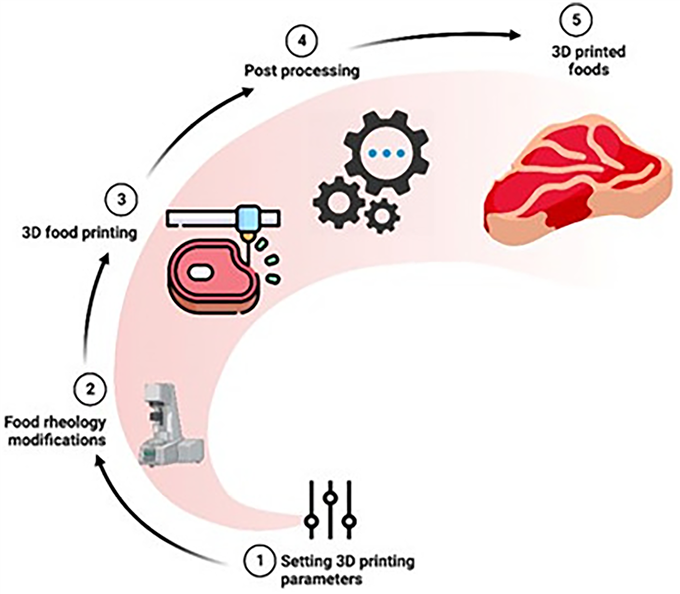 |
| Typical schematic of the 3D food printing process |
3. Revolutionizing Plant-Based and Cultured Meat
Livestock farming currently accounts for 18% of global greenhouse gas emissions. To mitigate environmental impact, 3D printing is being applied to develop meat alternatives from plant sources.
Companies such as Novameat and Redefine Meat have successfully created plant-based beef steaks (Alt-Steak) using blends of seaweed, rice, and pea protein, replicating the texture and mouthfeel of real meat with high fidelity. Similarly, 3D-printed salmon made from algal extracts and fungal protein has already reached the market.
A further advancement involves cultured meat (also known as cell-based or cultivated meat). By combining stem cell technology with 3D bioprinting, scientists can fabricate muscle tissue without animal slaughter. Notably, Aleph Farms has successfully demonstrated the printing of meat in microgravity environments aboard the International Space Station.
4. Personalized Nutrition: Tailor-Made Meals
One of the most humane applications of 3D food printing is catering to specific demographic and health needs:
- Elderly individuals and dysphagia patients: Instead of unappetizing purees, 3D printing enables the recreation of natural-looking foods (e.g., beans, meat chunks) with soft, swallow-safe textures, restoring the pleasure of eating.
- Military and space missions: In harsh environments, 3D printers integrated with wearable sensors can monitor real-time nutritional needs and produce customized nutrient bars. For long-duration space missions, the technology allows the creation of nutrient-dense meals from shelf-stable dry powders with up to 5 years of storage life.
- Children and athletes: Meals can be precisely tuned in terms of protein, vitamins, or fiber content based on genetic profiles or lifestyle requirements.
5. Turning "Waste" into Gourmet Products
3D food printing plays a vital role in the circular economy model. Food industry by-products, once discarded, can be valorized into valuable printable materials:
- Potato peels → nutrient-rich noodles
- Grape pomace and barley spent grain → functional cookies
- Salmon skin → gelatin-based bio-inks
- Sugarcane bagasse → sustainable, edible, or biodegradable food packaging to replace single-use plastics
6. Challenges and the Road Ahead
Despite its immense potential, several barriers remain:
Printing speed: Current rates are too slow for large-scale industrial production.
Consumer acceptance: Food neophobia and concerns about the safety of "machine-printed" food persist.
Cost: The price of specialized printers and food inks must decrease significantly for widespread household adoption.
Conclusion
3D food printing is far more than a novelty technology for creating intricate chocolate designs. It represents a strategic tool for achieving sustainable development goals, reducing resource waste, and enhancing public health through precision nutrition. Once technical hurdles are overcome, having a food 3D printer alongside a microwave in every kitchen may soon become a reality.
Translated and summarized by Dr. Le Thien Kim - Department of Biochemistry and Food biotechnology
Source: Thorakkattu, P., Awasti, N., Sajith Babu, K., Khanashyam, A. C., Deliephan, A., Shah, K., Signh, P., Pandiselvam, R. & Nirmal, N. P. (2025). 3D printing: trends and approaches toward achieving long-term sustainability in the food industry. Critical Reviews in Biotechnology, 45(1), 48-68.