Introduction
Food preservation remains one of the fundamental challenges in food technology, particularly in the context of increasing global demand for high-quality and minimally processed foods. Among modern preservation techniques, freeze drying (FD), also known as lyophilization, is widely recognized as one of the most advanced technologies due to its ability to maintain product quality close to that of fresh materials. This technique removes water from food through the sublimation of ice under low temperature and vacuum conditions, thereby minimizing biochemical and physicochemical changes during processing (Ratti, 2001).
Compared with conventional drying methods such as hot-air drying or spray drying, freeze drying offers several significant advantages. These include superior retention of cellular structure, preservation of natural color and flavor, and improved stability of bioactive compounds such as vitamins, polyphenols, and enzymes. Consequently, freeze drying is widely applied in the production of high-value food products, pharmaceuticals, biotechnological materials, and functional foods (Mujumdar, 2014).
Despite these advantages, freeze drying also presents several limitations. The process typically requires long processing times and consumes large amounts of energy, which significantly increases production costs and restricts widespread industrial adoption. In the context of sustainable food processing and energy-efficient manufacturing, improving the performance and sustainability of freeze drying systems has become an important research focus in food engineering (Al Faruq et al., 2025).
In recent years, numerous technological innovations have been developed to improve different stages of the freeze drying process, including freezing, primary drying, and pretreatment techniques. These innovations aim to reduce drying time, enhance product quality, and decrease overall energy consumption, thereby making freeze drying more economically and environmentally sustainable.
Principles of Freeze Drying
Freeze drying is a dehydration process that removes water from materials through the direct transition of ice from the solid phase to vapor without passing through the liquid phase. This process occurs under pressure conditions below the triple point of water (approximately 611 Pa) and at low temperatures, enabling frozen water within the food matrix to sublimate directly into water vapor (Ratti, 2001).
The freeze drying process generally consists of three main stages: freezing, primary drying, and secondary drying. During the freezing stage, the temperature of the food material is reduced below its freezing point, allowing the water contained in the product to form ice crystals. The size and distribution of these ice crystals are critical because they significantly influence the structural characteristics of the material during the subsequent drying stages.
    |
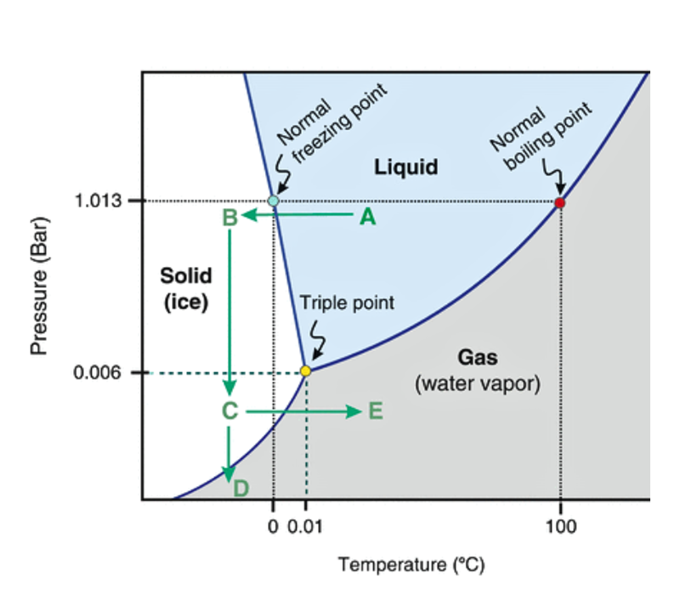 |
| Figure 1: Diagram of the basic principles of the freeze drying process |
Following freezing, the material is subjected to primary drying under vacuum conditions. In this stage, heat is supplied to the frozen product to promote sublimation of the ice crystals. The generated water vapor is then removed from the drying chamber and condensed on a cold condenser surface. Primary drying typically removes the majority of the free water present in the product and accounts for the largest portion of the overall drying time (Mujumdar, 2014).
The final stage is secondary drying, during which the remaining bound water molecules are removed from the material by gradually increasing the temperature. The objective of this stage is to reduce the residual moisture content to a very low level, typically below 5%, ensuring the long-term stability of the dried product.
Due to the low-temperature conditions of the process, freeze drying effectively limits chemical reactions such as Maillard browning and lipid oxidation, thereby preserving the nutritional and sensory properties of the product.
Advanced Freezing Technologies
The freezing stage plays a crucial role in determining the structural integrity and final quality of freeze-dried products. The size and distribution of ice crystals directly influence the formation of the porous structure that remains after sublimation. Large ice crystals may rupture cell membranes and damage tissue structure, whereas smaller and uniformly distributed crystals help maintain the microstructure and improve rehydration capacity (Ratti, 2001).
One of the advanced freezing techniques currently under investigation is radio-frequency-assisted freezing (RFAF). This technology uses high-frequency electromagnetic fields to stimulate molecular movement within the food matrix, promoting nucleation and reducing the size of ice crystals. As a result, structural damage to food tissues during freezing can be minimized (Manzocco et al., 2017).
Another promising method is high-pressure-assisted freezing (HPAF). Under high pressure conditions, nucleation occurs more rapidly, leading to the formation of numerous small ice crystals. This phenomenon helps reduce mechanical damage to cellular structures and improves the overall quality of frozen and subsequently freeze-dried products (Su et al., 2017).
Magnetic field-assisted freezing has also been explored as a novel technique to control ice crystallization. Magnetic fields may weaken hydrogen bonding among water molecules, facilitating nucleation and resulting in smaller ice crystals. This approach has the potential to enhance freezing efficiency and improve product quality during freeze drying (Al Faruq et al., 2025).
Improved Freeze Drying Technologies
To overcome the limitations of conventional freeze drying, several hybrid technologies have been developed to enhance heat and mass transfer during the drying process.
Microwave-assisted freeze drying (MFD) is one of the most widely studied approaches. In this technique, microwave energy is used to generate internal heating within the product through molecular vibration of water molecules. This volumetric heating mechanism significantly accelerates ice sublimation and can dramatically reduce drying time compared with conventional freeze drying methods (Chen et al., 2018).
Infrared radiation has also been investigated as an auxiliary heat source in freeze drying systems. Infrared heating allows direct energy transfer to the surface of the material, increasing the rate of heat transfer and enhancing sublimation efficiency. Several studies have demonstrated that infrared-assisted freeze drying can improve process energy efficiency (Huang et al., 2019).
Ultrasound-assisted freeze drying is another emerging technology. Ultrasonic waves generate mechanical vibrations and cavitation effects within the material, creating micro-channels in the food matrix. These structural modifications enhance moisture diffusion and improve mass transfer during drying (Xu et al., 2020).
Pretreatment Technologies to Enhance Drying Efficiency
Pretreatment techniques applied prior to freeze drying can modify the structure of food tissues and significantly enhance drying performance.
Pulsed electric field (PEF) treatment is one of the most promising pretreatment technologies. This technique induces electroporation in cell membranes, creating microscopic pores that increase membrane permeability and facilitate moisture removal during drying (Parniakov et al., 2016).
High pressure processing (HPP) has also been shown to improve drying kinetics in various food products. High pressure may induce structural changes in proteins and polysaccharides within the food matrix, increasing porosity and improving both heat and mass transfer during drying (Zhang et al., 2018).
Other innovative pretreatment techniques currently under investigation include cold plasma treatment, electrohydrodynamic processing, and radio-frequency blanching. These technologies aim to enhance structural modification of food materials and thereby improve freeze drying efficiency (Bußler et al., 2017).
Applications of Freeze Drying in the Food Industry
Due to its ability to preserve product quality, freeze drying has been widely applied in various sectors of the food industry.
In fruit and vegetable processing, freeze drying is commonly used to produce premium dried products such as strawberries, mangoes, bananas, and dragon fruits. These products are characterized by their lightweight structure, high porosity, and rapid rehydration properties.
Freeze drying is also extensively used in the production of high-quality instant coffee. Compared with other drying techniques, freeze drying better preserves the characteristic aroma compounds of coffee, resulting in superior flavor quality and higher commercial value.
In addition, freeze drying is widely employed in the production of functional foods, medicinal mushrooms, herbal products, and probiotic preparations. The low-temperature nature of the process helps protect sensitive bioactive compounds, ensuring higher biological activity and stability compared with conventional drying methods (Mujumdar, 2014).
Future Development Trends
Future developments in freeze drying technology will likely focus on improving energy efficiency and enhancing process sustainability.
The integration of advanced sensor technologies, such as near-infrared spectroscopy and hyperspectral imaging, enables real-time monitoring of product moisture content during the drying process. These data can be used to optimize operating conditions and improve process control.
Furthermore, the application of mathematical modeling and artificial intelligence in freeze drying systems has emerged as a promising research direction. Predictive models can simulate drying kinetics and optimize operational parameters, thereby reducing energy consumption and improving production efficiency (Al Faruq et al., 2025).
Conclusion
Freeze drying remains one of the most advanced food preservation technologies due to its ability to maintain high product quality. However, challenges related to high energy consumption and long processing times continue to limit its widespread industrial adoption.
Recent technological innovations have demonstrated that improvements in freezing techniques, drying methods, and pretreatment technologies can significantly enhance the performance of freeze drying systems. The integration of advanced technologies such as microwave heating, infrared radiation, ultrasound assistance, and modern pretreatment methods has opened new opportunities for improving both process efficiency and product quality.
Looking forward, the incorporation of smart sensors, digital process control, and artificial intelligence is expected to play an increasingly important role in optimizing freeze drying operations. These advancements will contribute to reducing production costs and promoting the broader application of freeze drying technology in sustainable food processing systems.
References
Al Faruq, A., Farahnaky, A., Dokouhaki, M., Khatun, H. A., Trujillo, F. J., & Majzoobi, M. (2025). Technological innovations in freeze drying: Enhancing efficiency, sustainability, and food quality. Food Engineering Reviews.
Bußler, S., et al. (2017). Cold plasma processing of food tissues. Innovative Food Science & Emerging Technologies, 42, 130–137.
Chen, X., et al. (2018). Energy consumption in microwave freeze drying. Drying Technology, 36, 1201–1210.
Huang, W., et al. (2019). Infrared assisted freeze drying of foods. Journal of Food Engineering, 244, 70–78.
Manzocco, L., et al. (2017). Radiofrequency assisted freezing of foods. Food Research International, 100, 236–242.
Mujumdar, A. S. (2014). Handbook of industrial drying. CRC Press.
Parniakov, O., et al. (2016). Pulsed electric field treatment in food processing. Trends in Food Science & Technology, 55, 12–23.
Ratti, C. (2001). Hot air and freeze drying of foods. Journal of Food Engineering, 49, 311–319.
Su, Y., et al. (2017). Ice crystal formation under high pressure freezing. Food Chemistry, 218, 122–128.
Xu, Y., et al. (2020). Ultrasound pretreatment before freeze drying. Drying Technology, 38, 1100–1110.
Zhang, M., et al. (2010). Freeze drying of food materials. Drying Technology, 28, 341–356.
Zhang, Y., et al. (2018). High pressure pretreatment and drying kinetics. Food and Bioprocess Technology, 11, 1515–1525.