On 2 November 2026, the Research Group on Green Food Technology and Sustainable Development, Faculty of Food Science and Technology, Vietnam National University of Agriculture (VNUA), in collaboration with the Japan Food Safety Management Association (JFSM), organised the scientific seminar “Practical Food Safety Management”. The presentations focused on the prevention of foreign material contamination and JFS Standards, JFS certification services in Vietnam, and the need for food safety human resource training.
The seminar brought together 64 participants, including 2 Japanese experts, 19 faculty members and staff, 31 undergraduate and postgraduate students of the Faculty of Food Science and Technology, and 12 representatives of food businesses, a certification body and a professional association. With its focus on green food technology, the research group regards food safety as the foundation of a sustainable food chain: a recalled batch not only causes economic and reputational damage but also results in food loss and waste. Prevention at the source therefore both ensures safety and supports the goal of green production.
Opening the seminar programme, Mr. Masanori Kotani, President of JFSM, delivered a presentation entitled “Practical Food Safety Management and JFS Standards: Lessons from Foreign Material Contamination Prevention”, approaching the issue from the production practices of Japanese companies. The presentation highlighted the Japanese approach of prevention at three levels: GMP – HACCP – Food Safety Culture. Its central message was that foreign material detection equipment is necessary but cannot replace a prevention system, which is built on three complementary levels:
GMP and prerequisite programmes: material control, equipment maintenance, tool management, pest control, personal hygiene and the application of 5S.
HACCP: analysis of physical hazards at each processing step, identification and monitoring of critical control points, corrective actions and verification.
Food safety culture: leadership commitment, employee training, encouragement of early reporting and continuous improvement in the spirit of Kaizen.
JFS Standards are built on three pillars – GMP, HACCP and Food Safety Management (FSM) – allowing businesses to upgrade step by step in line with their actual resources. The presentation also introduced the benefits of a structured management system and the support programmes available to Vietnamese food businesses interested in JFS Standards.
    |
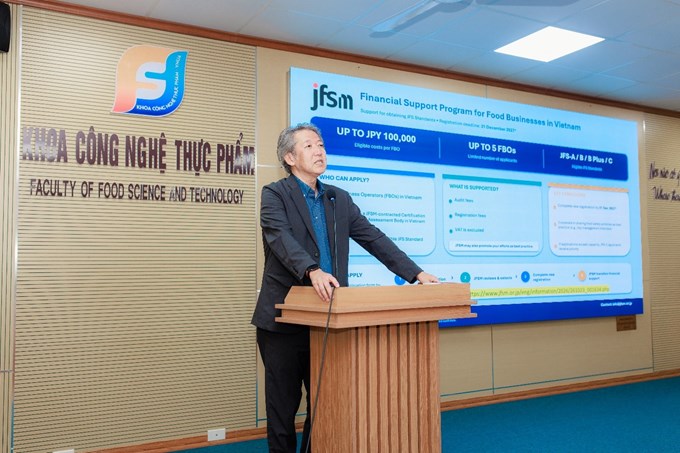 |
| Mr. Masanori Kotani, President of JFSM, delivers his presentation |
Next, Mr. Nguyen Nam Son, Chief Expert, representing the VinaCert Certification and Inspection Joint Stock Company, introduced the company and gave an overview of JFS certification services in Vietnam. The presentation analysed the benefits of certification for businesses: enhancing credibility with customers, meeting the requirements of retail chains and importers, and expanding access to the Japanese and international markets. VinaCert also shared its expectations of Vietnamese food businesses: proactively building internal systems before audits, selecting the JFS level appropriate to their current capacity and maintaining continuous improvement after certification. The presentation gave participants a clear picture of the path from system development to independent audit and certification.
On behalf of the Faculty of Food Science and Technology, Dr. Phan Thi Phuong Thao presented the food safety training needs and potential areas of cooperation with JFSM. The presentation drew on practical results: under the ASEAN–MAFF–HRD Project, the Faculty collaborated with JFSM to organise five Food Safety Management training courses for 422 participants, which received positive feedback on their professional quality and applicability. On this basis, the presentation identified key needs: training food safety professionals and auditors; developing training programmes and materials linked to industry practice; and strengthening academia–industry linkages. These areas are reflected in the Memorandum of Understanding between VNUA and JFSM, signed on the day of the seminar, with the Faculty of Food Science and Technology as the focal unit.
The three presentations formed a coherent narrative: from technical solutions for preventing foreign material contamination and JFS Standards, to the certification pathway for businesses and the need for human resource training as the foundation for long-term cooperation. As the organiser, the Research Group on Green Food Technology and Sustainable Development will continue to serve as a bridge between international knowledge, research and industry, towards a safe and sustainable food sector.
Research Group on Green Food Technology and Sustainable Development
Faculty of Food Science and Technology